
What Are MAE and MFE in Trading? (With Examples)
Short answer: MAE (maximum adverse excursion) is the furthest a trade went against you while it was open. MFE (maximum favourable excursion) is the furthest it went in your favour. Both are measured from your entry price, in points, dollars or R. Together they show whether your stops and exits fit how your trades really move.
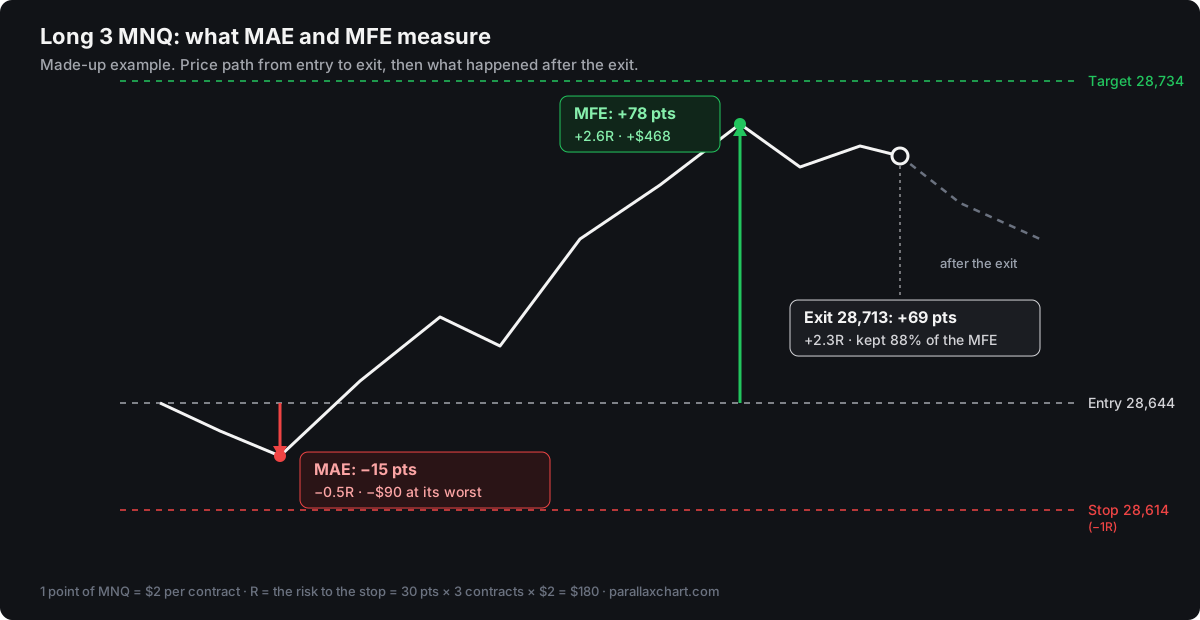
MAE and MFE at a glance
| MAE | MFE | |
|---|---|---|
| Full name | Maximum adverse excursion | Maximum favourable excursion |
| Measures | The worst point of the trade | The best point of the trade |
| For a long trade | Entry − lowest price while open | Highest price while open − entry |
| For a short trade | Highest price while open − entry | Entry − lowest price while open |
| In the example | 15 points (−0.5R, −$90) | 78 points (+2.6R, +$468) |
Working it out: the example trade
Long 3 MNQ contracts (each point is worth $2 per contract), stop 30 points below the entry:
| Price | Points from entry | Dollars (3 MNQ) | R | |
|---|---|---|---|---|
| Entry | 28,644.00 | 0 | $0 | 0 |
| Stop | 28,614.00 | −30 | −$180 | −1R |
| Lowest price while open (MAE) | 28,629.00 | −15 | −$90 | −0.5R |
| Highest price while open (MFE) | 28,722.00 | +78 | +$468 | +2.6R |
| Exit | 28,713.00 | +69 | +$414 | +2.3R |
Dollars = points × contracts × $ per point. R = points ÷ the distance to the stop (30 points). New to R? Read What Is an R Multiple?
What MAE and MFE show
| Question | What to look at |
|---|---|
| Is my stop wider than my winners need? | The MAE of winning trades: how far they went against you before working |
| Do my losers go straight against me? | The MAE of losing trades, compared with the stop |
| Am I leaving money on the table? | MFE compared with the exit: the example kept 69 of 78 points (88%) |
| Do my targets fit how far trades run? | The MFE of all trades, compared with your target |
| What happened after I got out? | The move after the exit, in the same direction or against it |
Exit efficiency is one way to sum it up: the P&L you kept ÷ the MFE. In the example, 69 ÷ 78 = 88%. Across many trades, it shows how much of the available move your exits usually capture.
How to track MAE and MFE
| Method | How | Catch |
|---|---|---|
| By hand | Look at the chart after each trade and note the highest and lowest price while you were in | Slow, and easy to get wrong on fast trades |
| Spreadsheet | Add columns for the highest and lowest price while you were in, and work MAE and MFE out from them. Our free trading journal template has room to add them | You still look up the high and low for every trade |
| A journal that works it out | Parallax Trading Journal reads Sierra Chart’s own price data for each trade and shows MAE, MFE and the trade’s P&L path, with the move after the exit | Sierra Chart on Windows |
Parallax has a 7-day free trial. See the journal.
Common mistakes
- Mixing directions: for a short trade, MAE comes from the highest price, not the lowest.
- Measuring from the wrong price: MAE and MFE are measured from your entry, not from the open of the bar.
- Comparing raw points across markets: convert to R when you compare MNQ with MES or CL, so different sizes and stops line up.
- Judging from one trade: a single MAE says little; patterns show up over dozens of trades.
Frequently asked
What does MAE mean in trading?
Maximum adverse excursion: the largest unrealised loss a trade showed while it was open, measured from the entry.
What does MFE mean in trading?
Maximum favourable excursion: the largest unrealised profit a trade showed while it was open, measured from the entry.
Can MAE be zero?
Yes. If price never went past your entry against you, the MAE is zero. The same goes for MFE on a trade that went straight against you.
Should MAE and MFE include commission?
They’re usually measured on price alone, before commission, so they describe how the market moved. Your P&L includes commission.